Failure is not the end of the story. For most entrepreneurs, it’s actually the beginning.
That’s one of the clearest insights from our latest survey of 200 U.S. tech company founders: Over 80 percent of them said that going through a startup failure—the worst thing imaginable for most founders—actually makes them more likely to launch a new company, not less.
Folding a startup might seem like the end of the world, but for most founders failure is part of the journey. In fact, for many it’s simply motivation.
For more than a decade, Wilbur Labs has studied why some startups succeed while so many others flame out. This year we go deeper into the founder experience: what motivates them, what stresses them out, what mistakes they’ve made, and, most important, what lessons they’ve learned along the way.
In February 2026, we commissioned our third original survey of entrepreneurs, asking them to reflect on the realities of company building. Some of the results are striking, including 87% of founders who said starting a company is lonelier than anticipated. Nearly 60% of respondents said they are concerned daily about their company going out of business in the next 12 months, with the threat of AI—the “new” company killer—ranking as the primary reason. (We brought in Wakefield Research to help administer the survey, and our methodology is detailed below.)
Many of the big themes that emerged this year also reinforce what decades of research and our own experiences indicate: Failure is common but rarely random, pivoting has become the norm, product-market fit still matters most, and building a company is way more stressful than the flashy headlines let on.
Every failure is unique, obviously. But in researching why some startups don’t make it, patterns tend to emerge. Mistakes repeat. Companies stumble for identifiable reasons. The encouraging news is that founders who recognize those patterns—and learn from others who’ve seen them, too—dramatically improve their chances of success.
In that spirit, we’re using our most recent survey, along with findings from past surveys, to examine where startups go wrong. The resulting insights can help founders improve their odds of success this year and for years to come.
81% of founders who experienced failure are motivated to start another company
Key Findings
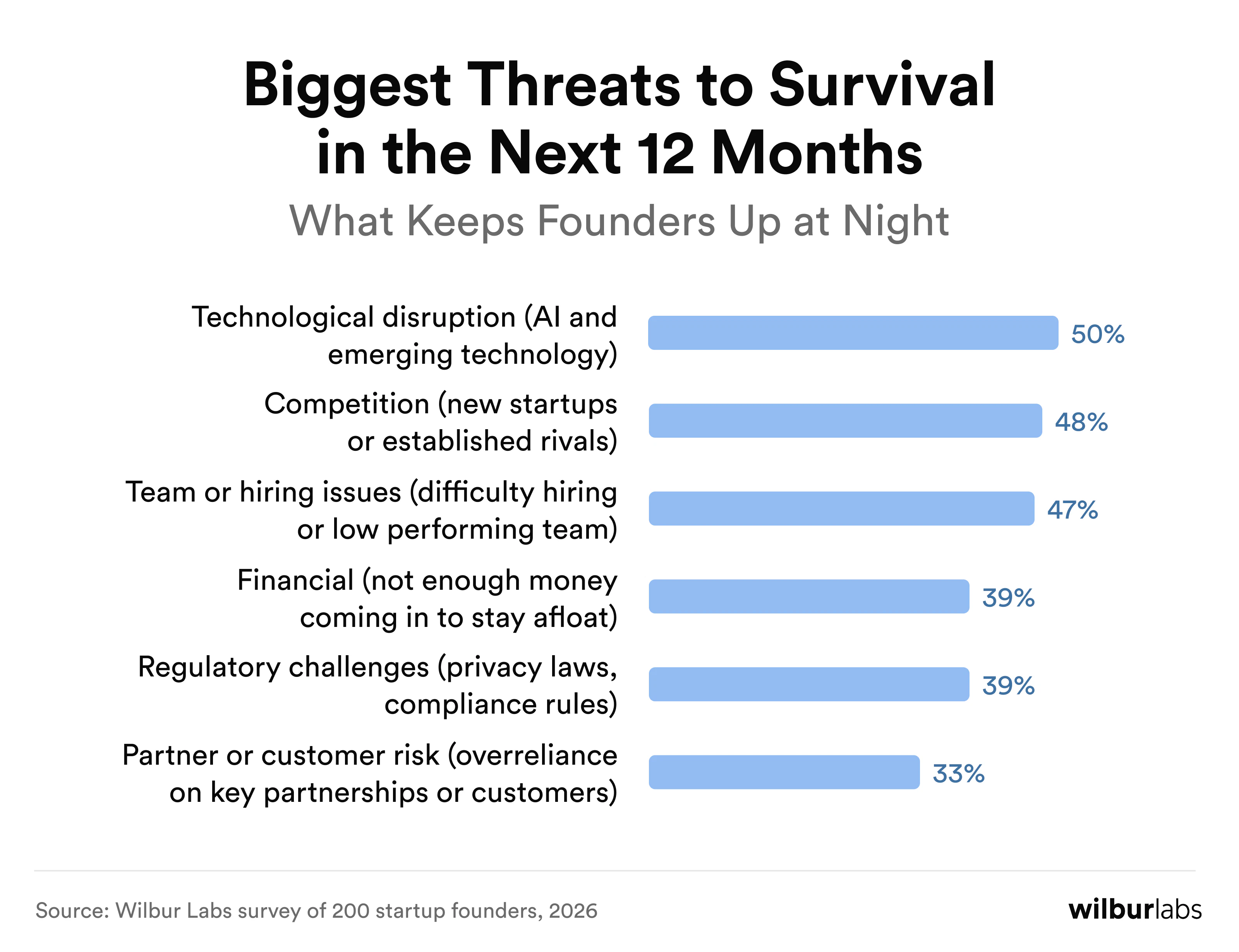
50% of founders feel technological disruption, including AI, is the top threat to their company
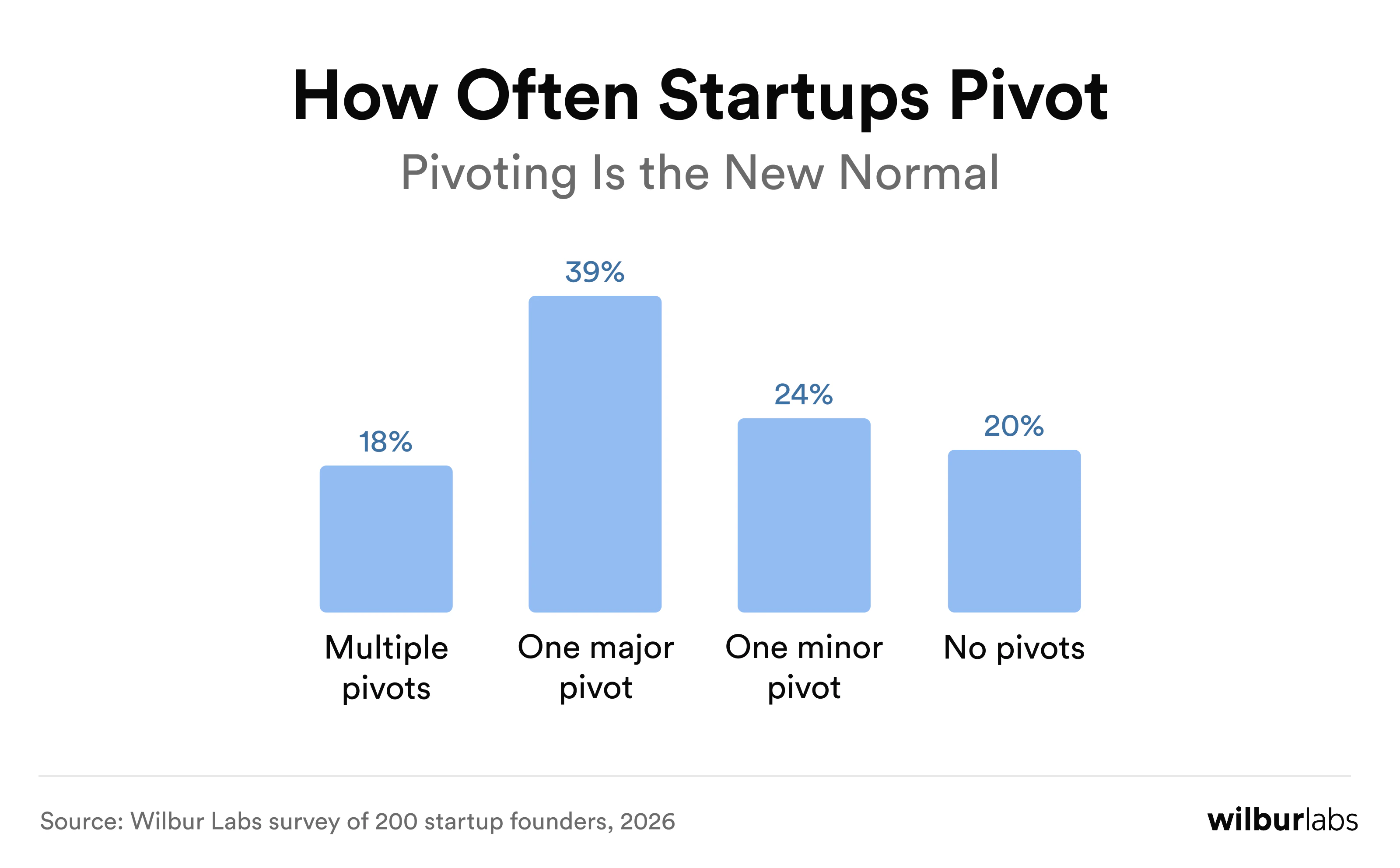
81% of founders pivoted from their original idea at least once, while 42% wish they had pivoted or changed their business model sooner
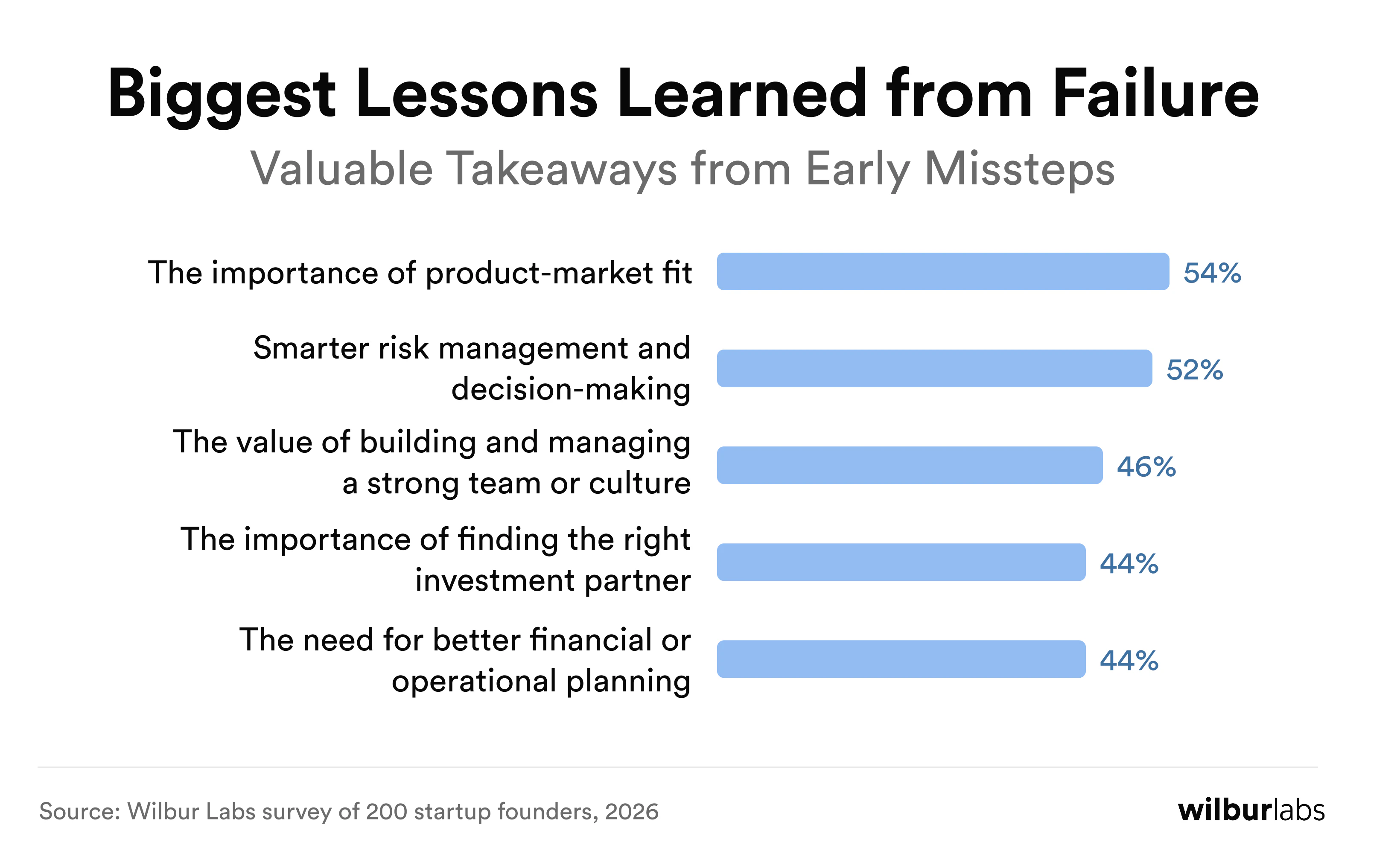
54% of founders said the most important lesson they learned from failure was the need to better understand product-market fit
87% of founders in our survey said building a company was lonelier than expected
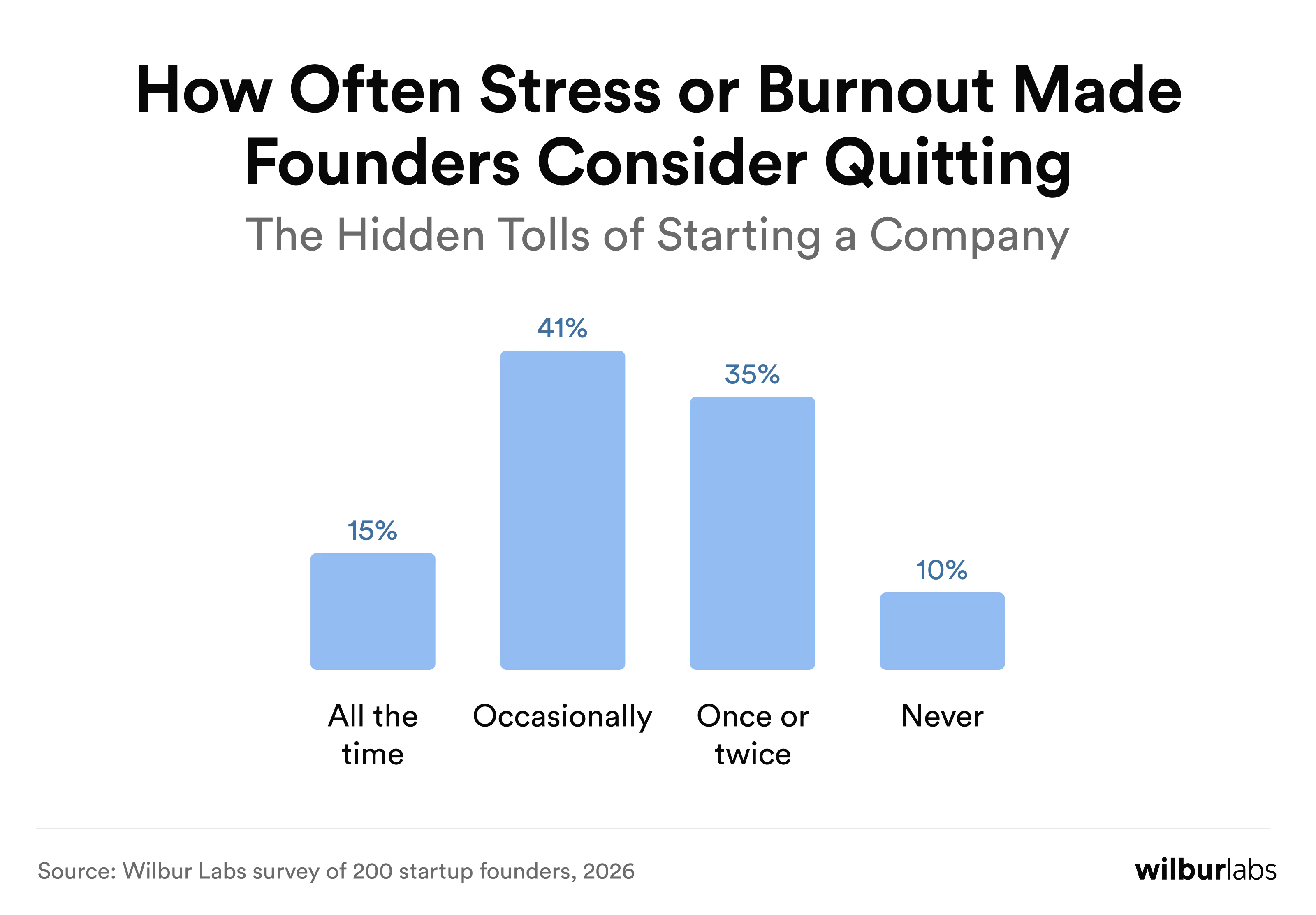
90% of founders said they experienced stress or burnout severe enough that it made them consider quitting
81% of founders who failed remain open to starting another company; 31% were motivated to do so immediately
The world loves to celebrate visionary founders who build enduring companies, yet most startups do not survive the first few years, let alone become household names.
Roughly 70-90% of startups fail, depending on the dataset and time frame. Nearly a quarter of new businesses shut down in their very first year, according to the U.S. Bureau of Labor Statistics. An additional 25% fail during the critical window, between year two and five, when early traction gives way to the difficult work of building a sustainable business model.
Venture-backed companies often fare no better. In one of the most widely cited studies on entrepreneurship, from Harvard Business School, researchers estimated that as many as three-quarters of startups fail to return capital to investors, showing just how uncertain the path to success is. And yet entrepreneurship is seemingly one of the few professions where failure not only isn’t a dead end, but is often a launchpad for future attempts.
Beyond the fact that four out of five founders were still motivated to start another company after having gone through a failure, 31% said it motivated them to found another company immediately. An additional 51% said they would start another company but be more cautious. Not one person in our survey said failure would cause them to stop pursuing entrepreneurship altogether.
Not one founder said a failure would stop them from starting another company
This dynamic shows up repeatedly in startup research and is backed by the experiences of some of the most recognizable entrepreneurs in technology. Nick Woodman, the founder of GoPro, first launched a gaming and marketing platform called Funbug, in 1999, which folded when the tech bubble burst; he soon came up with the idea for an action-shot camera during the ensuing surf trip he took as a mental reset. Stewart Butterfield’s gaming company failed when its online game Glitch shut down, but the internal communication tool his team built became Slack. Travis Kalanick’s first startup, a peer-to-peer file-sharing search engine called Scour, was forcing the startup into bankruptcy after several massive entertainment companies sued Scour for copyright infringement. He went on to found Uber.
Every failed startup teaches founders something about markets, hiring, timing, and strategy. Serial founders often identify problems earlier, change their strategy faster, and allocate resources more efficiently than first-time entrepreneurs. They are also more realistic about the challenges ahead.
If startup failure were truly career ending, entrepreneurship would be far less common. For founders willing to study their mistakes, seek advice, and apply what they’ve learned, a failed startup can become the most valuable training they’ll ever get.
Failure, in that sense, is better viewed not as a setback but as simply part of the process.
Pivoting Is the New Normal
Startup mythology often portrays the founding of a company as a lightning strike: A founder comes up with a breakthrough idea, develops a product that instantly resonates, and the company takes off like a rocketship.
The reality is far messier.
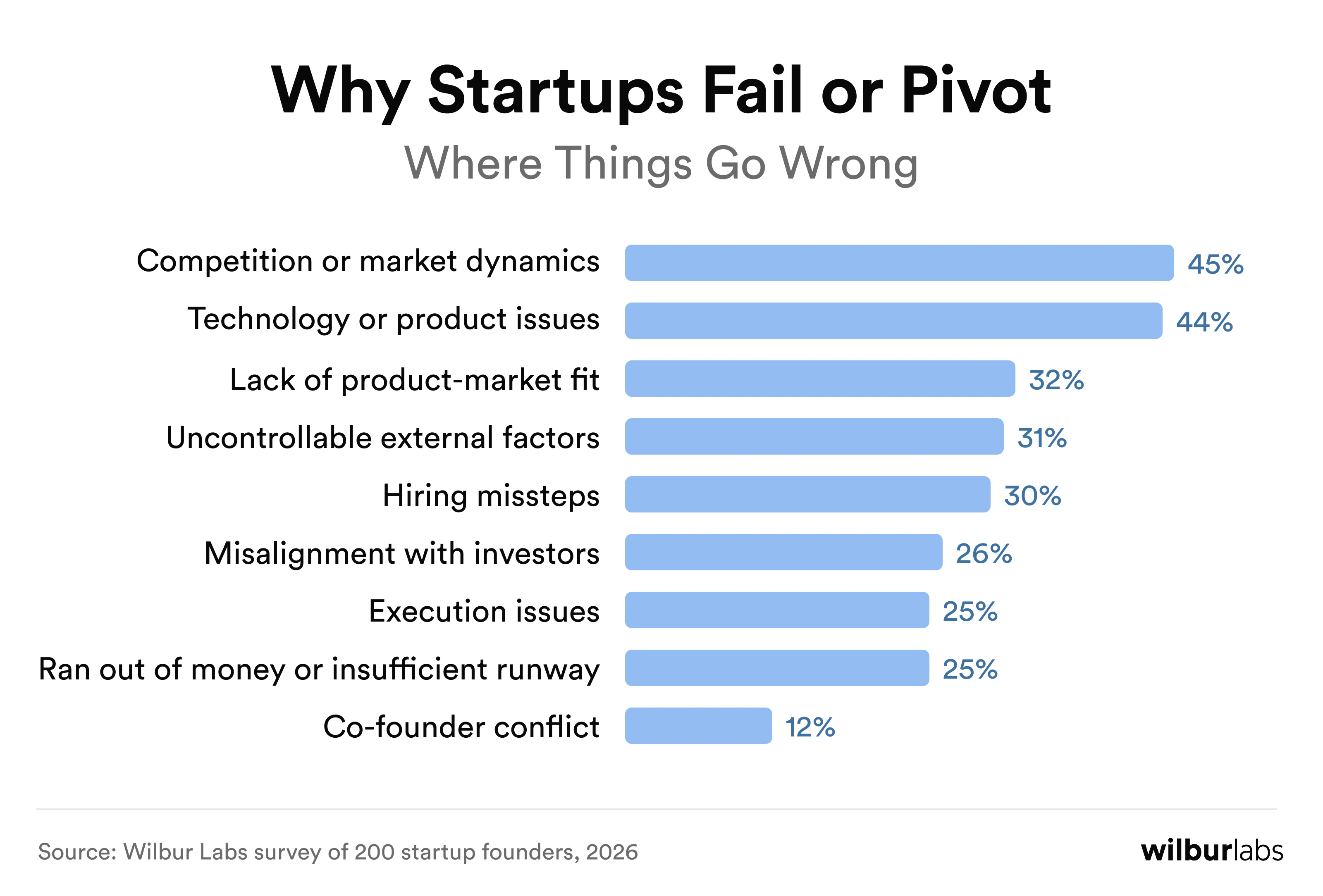
According to our 2026 Wilbur Labs survey, 81% of founders said their company pivoted from its original idea, with 57% making a major pivot or multiple pivots. When asked why their company failed or needed to pivot, founders most often pointed to competition and shifting market dynamics (45%), followed closely by technology or product issues (44%).
Pivoting has always been a part of startup life. Some of the most successful technology companies began as something entirely different. Shopify began in 2004 as Snowdevil, an online snowboard shop. Instagram began as a cluttered location-based social app called Burbn before its founders realized users were drawn almost exclusively to its photo-sharing feature. Even YouTube was originally conceived as a video dating site before its creators noticed that people simply wanted a fast way to upload and share videos. (For a primer on how to brainstorm potential revenue-generating ideas, see our blueprint “How to Get Startup Ideas.”)
Still, these shifts were often exceptions, not the rule. Our survey seems to indicate that pivoting is the new norm for many startups, and it also likely reflects a broader evolution in how they operate today. The traditional model of launching with a fixed product and scaling quickly has largely given way to a more iterative approach: build, test, learn, and adjust.
The most effective founders approach their initial idea as a hypothesis rather than a conclusion. They expect the company to evolve as they learn more about customers and the market. Plans are not static documents but working frameworks that improve continuously as new data and feedback emerge.
The first idea is rarely the final one.
Without Product-Market Fit, Nothing Else Matters
If there is a single thread running through decades of startup research, it is the importance of market alignment.
Our 2026 survey backed this up. More than half of founders (54%) said the most important lesson they learned from failure was the need to better understand product-market fit, making it the top takeaway from their entrepreneurial experiences. Interestingly, in our 2023 survey, conducted in the wake of the pandemic, founders most often cited running out of money as the primary cause of failure (38%). By 2026, that number fell to 25%, with founders more often pointing to technology or product issues (44%), external factors outside their control (31%), and hiring missteps (30%). One possible explanation is that the AI era has made it faster and cheaper to build, launch, and find early signals of traction, making funding less likely to be seen as the first constraint.
But whether founders point to capital, competition, or product challenges, the underlying story is often the same. Startups rarely fail because of one problem, or simply because they ran out of money. They fail because they have not found a market for their product, or because they did not adjust when the market told them it was time to change direction.
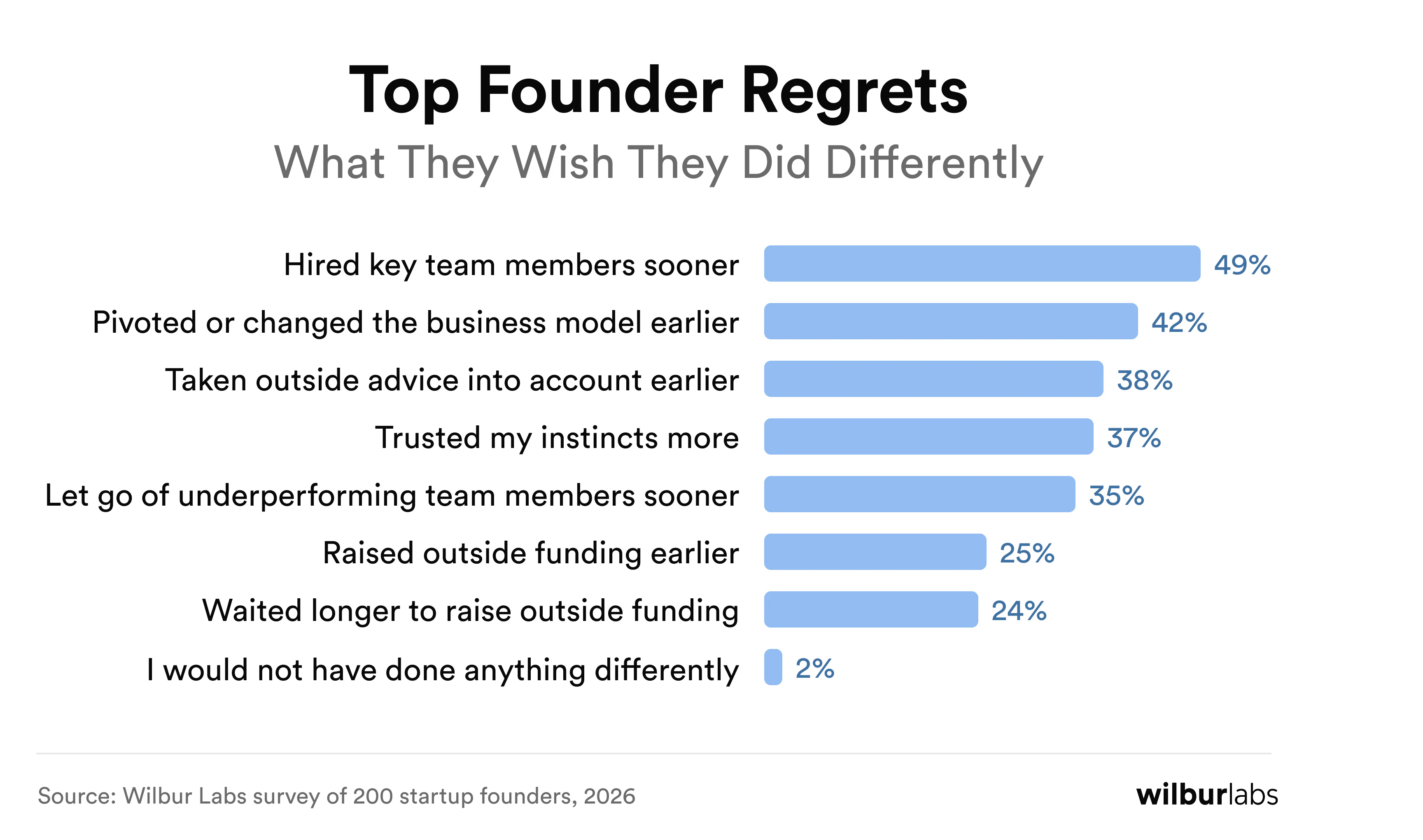
This is why the timing of pivots matters so much. Nearly 42% of founders in our 2026 survey said they wished they had pivoted or changed their business model sooner. Too many teams hold on to early assumptions longer than they should, often burning valuable time and capital in the process.
42% of founders said they wished they had pivoted or changed their business model sooner
The goal is not to abandon the vision behind the company, but to refine it until the product aligns with a real and durable market need.
Top Startup Mistakes: What Founders Actually Learn from Failure
In our 2026 survey, founders were clear about the lessons they learned from failure.
The most common was the importance of understanding product-market fit, as mentioned above, but more than half (52%) also said they needed smarter risk management and decision-making. The most interesting lessons, however, were about people. Forty-nine percent of founders said they wished they had hired key team members sooner, while 35% said they wished they had let underperforming employees go earlier. This tracks with what we at Wilbur Labs have seen ourselves: Founders too often hesitate on team and talent decisions. They both wait too long to hire and then hesitate too much about firing an underperforming employee or executive. Hiring decisions carry enormous weight in young companies, where every employee can influence the direction and culture of the business. This can slow growth and drain resources in a company where one bad hire can represent a significant percentage of the total workforce.
As we noted earlier, another lesson learned is the importance of making pivots at the right time: 42% of founders said they wished they had changed their business model sooner, reinforcing the idea that startups rarely fail because founders change direction too often, but because they hold on to the wrong idea for too long.
In our experience, startups rarely fail because of one dramatic mistake. Usually a series of small miscalculations compound over time. But that’s also where experience comes into play. Founders with a company or two behind them often learn to recognize warning signs earlier, hire more carefully, and adapt faster when markets change.
This firsthand experience matters in ways that are often overlooked in startup mythology. While popular narratives celebrate college dropouts building billion-dollar companies, research from MIT and the Kauffman Foundation found that the average age of successful startup founders is closer to 45. In our survey, 58% of founders started their first company between the ages of 30 and 39. Only 20% took the leap before age 30, which may not entirely debunk the “college dropout” myth but certainly offers a compelling counterpoint. Most entrepreneurs seem to wait until their mid-thirties to start a company, and they may be better off because of it.
Taken together, these regrets point to something we have seen: Founders usually don’t fail because they work too little or take too many outsize risks. They fail because they misjudge markets, delay difficult hiring decisions, or hold on to the wrong strategy for too long.
The Human Cost of Entrepreneurship: Burnout and Isolation
Starting a company can be exhilarating. It’s also one of the most stressful jobs there is, and the pressure is real.
In our 2026 survey, 90% of founders said they experienced stress or burnout severe enough that it made them consider quitting. For 15%, that feeling is constant. Another 41% said they considered quitting occasionally.
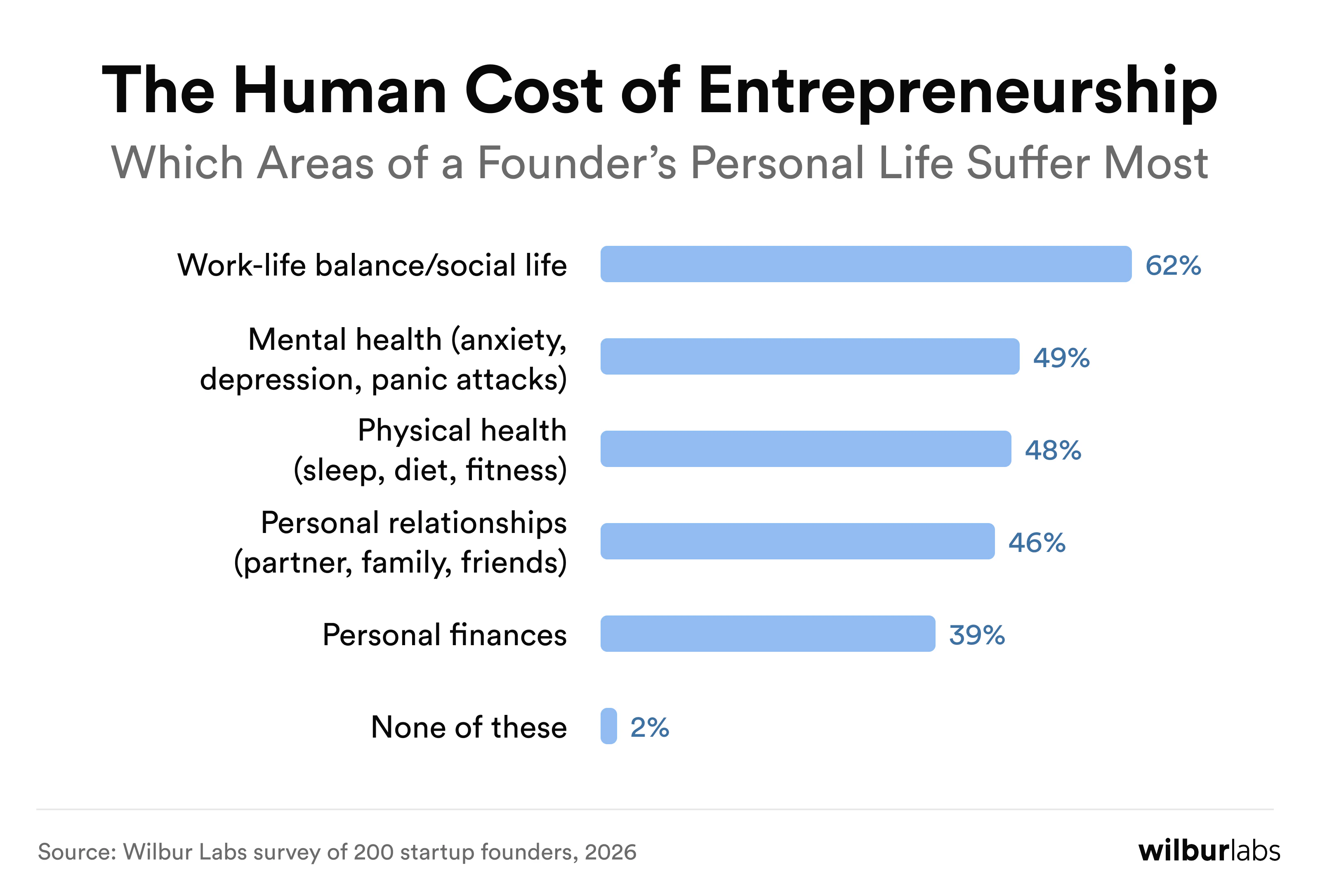
The strain shows up across every part of life. Work-life balance was one of the biggest casualties, with 62% of founders saying their social life suffered. Nearly half reported mental health challenges such as anxiety, depression, or panic attacks. An additional 48% experienced physical health issues tied to sleep, diet, or fitness. Personal relationships were also impacted, with 46% saying relationships with their partner, family, or friends suffered. This is the “founder’s tax,” and nearly everyone pays it.
What many founders also don’t anticipate is how isolating the experience can be. Eighty-seven percent of respondents in our survey said building a company was lonelier than expected. The emotional strain is closely tied to the uncertainty founders live with every day.
87% of respondents in our survey said building a company was lonelier than expected
Entrepreneurship is often romanticized as independence and ambition, but in practice it can also be isolating. That reality helps explain why experienced founders emphasize the importance of mentorship, trusted advisers, and strong teams. Research from UC Berkeley Fung Institute for Engineering Leadership determined that founders who receive guidance from experienced entrepreneurs make better strategic decisions and build more sustainable companies.
That support matters, especially given how many founders start alone. In our survey, 56% launched their company solo. Without co-founders or early teams, the emotional burden often falls entirely on one person. Also, the pressure rarely disappears, even with success.
Among founders in our survey, 59% said they are concerned about their business surviving the next 12 months. For founders, uncertainty is not a phase. It is a constant condition.
59% said they are concerned about their business surviving the next 12 months
Technological disruption, particularly from AI, was the most cited threat, followed closely by competition and hiring challenges.
The founders who last are not just the ones with the best ideas. They are the ones who build support systems, manage their energy, and find ways to keep going when the pressure increases.
Building a company may start with a single idea, but enduring the journey rarely happens alone.
What the Data Tells Us: Key Takeaways for Founders
Across a decade of research, founder interviews, and now three Wilbur Labs surveys on startup failure, a consistent theme emerges: Entrepreneurship is difficult, and success requires that founders defy the odds on a daily basis.
Most startups fail. Nearly every founder has setbacks. Yet most still managed to find a way through, despite the bumps along the way, perhaps because of the unique driving forces pushing them through tough times.
While lessons can be learned the hard way, most great founders also learn from others, to avoid obvious mistakes. Having examined why startups fail for nearly a decade now, and having listened to founders on what they wish they had done differently, here’s what we’ve learned over the years:
Lack of product-market fit remains the #1 reason startups fail. Research and plan obsessively before you get started, and focus on one goal: Making sure you're building something people actually need. In our 2023 survey, 72% of founders said a better business plan would have improved their odds of success. But don’t stop searching for your market once a business plan is in hand. Iterate relentlessly until customers are voting with their wallets or their time. Unless your product is pulling customers in faster than you can keep up, reaching product-market fit should remain your highest priority.
Pivoting is the norm. Don’t let sunk costs get in the way. In our survey, 81% of founders pivoted from their original idea at least once, and 42% wish they had pivoted or changed their business model sooner. The lesson here: Don’t be afraid to change course if you’re not reaching paying customers. But pivoting is a delicate decision. It’s just as important to muster the resilience to push through when times are tough and not abandon a good idea too soon. Success often comes down to finding the balance between grit and flexibility, pushing hard enough to weather the inevitable rough patches, but knowing when a bigger opportunity calls for a change in direction.
AI disruption is the biggest threat, but potentially also your biggest advantage. In our survey, 50% of founders identified technological disruption, including AI, as the top threat to their company. However, incumbents face the same challenge, and where there is disruption, there is opportunity. Startups can move faster than legacy companies, and if you focus on solving real problems better than anyone else, AI becomes a tool rather than a threat.
Failure doesn’t stop founders. Building a company is hard, but founders keep coming back. Nine out of ten in our survey experienced stress or burnout severe enough to make them consider quitting, yet 81% of those who failed remain open to starting again. That resilience is why entrepreneurs are the engine of innovation.
Entrepreneurship will always involve uncertainty, but it does not have to be guesswork. This perspective has shaped how we think about building companies at Wilbur Labs and why we believe studying failures is so valuable. Each setback offers lessons that can help founders make better decisions, adapt faster, and improve their odds.
In the end, lasting companies are built not by founders who get every decision right from day one, but by those who keep learning and improving over time.
Founder Profiles & Demographics
Beyond company outcomes, our study offers a closer look at founders themselves. It offers a clearer view of who founders are, what drives them, and how they begin.
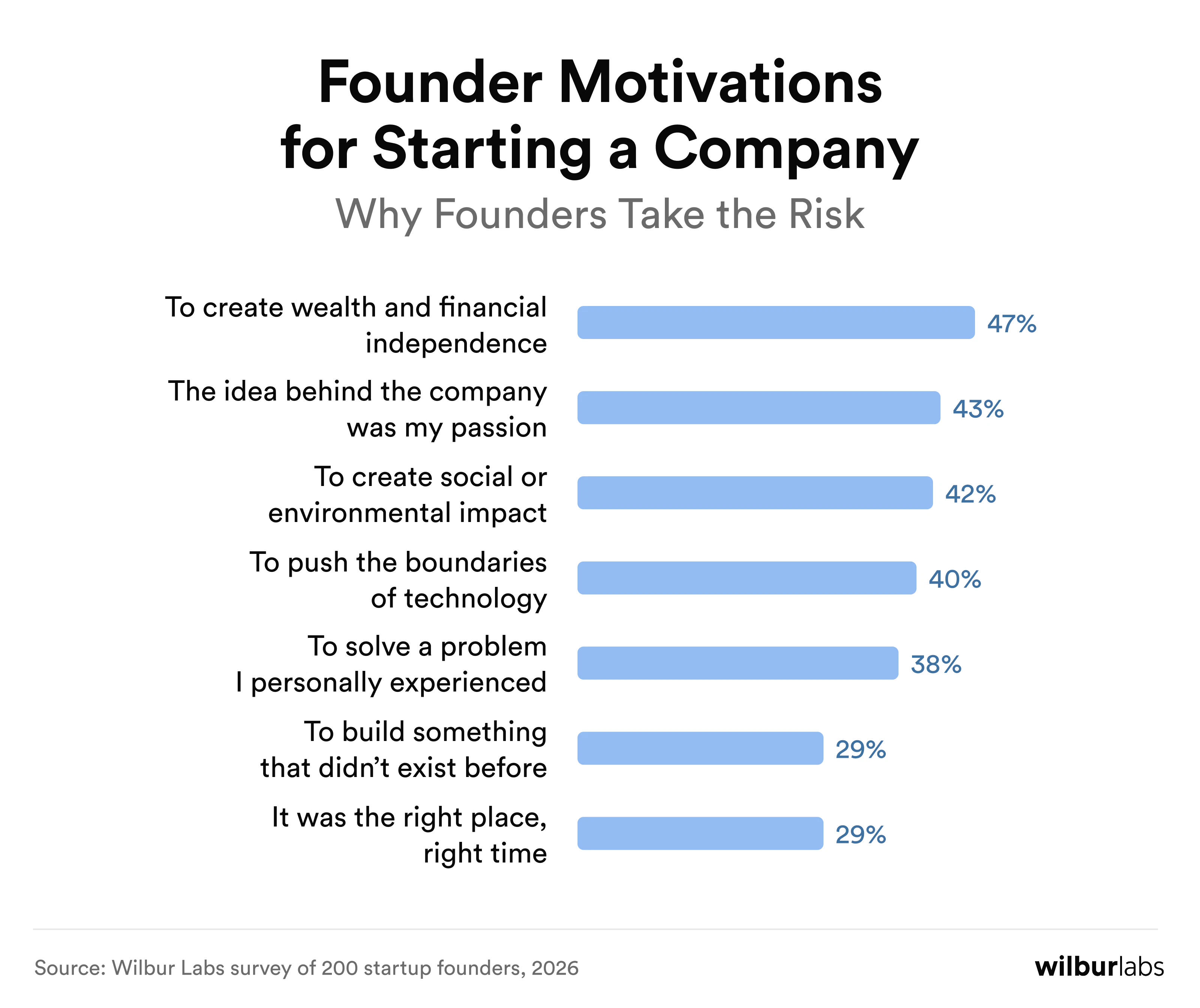
The reasons founders started a company: 47% to create wealth or financial independence, and 43% are driven by passion for an idea.
Founders’ starting age: 58% of founders start their first company between the ages of 30 and 39. Only 20% took the leap before age 30.
Solo vs. Co-Founder: 55.5% of founders launched their current company solo, while 44.5% started with co-founders.
The Serial Founder: 55% of founders have started just one company, while 24% have launched two, and 22% have founded three or more.
Methodology
This study was designed and conducted by Wilbur Labs as part of our ongoing research into startup failure and founder experiences. Wilbur Labs engaged Wakefield Research to assist with survey administration. The survey was fielded between February 3 and February 12, 2026, using email invitations and an online questionnaire. Respondents were asked a mix of multiple-choice and open-ended questions about their experiences building startups, including company failures, pivots, operational challenges, and lessons learned.
As with any survey research, results are subject to sampling variation. For the 200 interviews conducted in this study, the margin of sampling error is ±6.9 percentage points at the 95% confidence level. In addition, the survey relies on founders’ self-reported experiences, which may be influenced by factors such as attribution bias, exaggeration, telescoping, and recency bias.
Fair Use Statement
We hope the information presented in this study helps startup founders build successful businesses and avoid the pitfalls discussed here. In that spirit, we welcome others to share our findings and graphics, provided they attribute the work to Wilbur Labs and link back to this page.
Wilbur Labs is a startup studio. We turn bold ideas into market-leading companies.